Have you ever wanted to leave everything behind and head out on the road in an old van? Most people have, at least once. That restless urge sits at the heart of Into the Wild, Sean Penn’s raw and deeply affecting film based on the real story of Christopher McCandless, the young man who renamed himself Alexander Supertramp. His journey carried him across a huge and varied America, from the scorched desert edges of California to the silent, glacial reaches of Alaska.
What follows is a guide to the film’s most memorable locations, scattered across the country like pieces of a long, unfinished story. This is not an easy route, and it is not a conventional vacation in the usual sense. It is a road trip for people drawn to distance, weather, uncertainty, and the uneasy beauty of places that still feel bigger than us.
Emory University
In the Film
This is where Christopher McCandless’s old life ends and Alexander Supertramp begins.
The Emory graduation scene captures the exact kind of comfortable, respectable success that the hero is trying to escape. Chris earns his diploma. His parents glow with pride. They talk about his future as if it has already been decided for him, as if the path ahead is obvious, sensible, and clean. But by then he is already somewhere else in his mind. He has started pulling away from the life everyone expects him to want.
It is here, in that carefully ordered academic world, that the real break begins. He decides to give away the $24,000 he has saved, cut ties with the identity he has been handed, and disappear. The emotional force of this place comes from the tension between the life that had been laid out for him and his far more dangerous desire for something real.

About the place
Address: 201 Dowman Dr, Atlanta, GA 30322, USA
Emory University is one of the most respected private universities in the United States and is known for its elegant architecture, old trees, and quiet campus. Walking there now, you can still imagine the early scenes of the film unfolding along those same paths.
The graduation scenes were filmed at Randolph Hall, and the area still holds that same air of conservative academic calm. It is open to visitors, which makes it an easy and meaningful first stop for anyone tracing the emotional beginnings of McCandless’s journey.

Lake Mead National Recreation Area
In the Film
At Lake Mead, the transformation becomes irreversible.
Caught in a sudden flash flood zone, Chris is forced to abandon his old Datsun. But rather than treating it as a setback, he reads the moment almost like a sign. The car, the cash, the paperwork, the ordinary markers of identity and ownership all belong to the person he is trying to leave behind. Here, he burns what remains of his money and destroys his documents. Christopher McCandless disappears, and Alexander Supertramp takes his place.
It is one of the most symbolic scenes in the film. Fire and water do the work together. One washes away, the other consumes. What remains is a man trying to exist outside the systems that defined him.

About the place
Landmark: Hoover Dam area, Arizona–Nevada border, USA
Lake Mead National Recreation Area surrounds the vast reservoir created by the Hoover Dam, and the landscape has the severe beauty the film captures so well. The terrain is all sharp mineral color: rust-red rock, pale dust, scorched earth, and intensely blue water that feels almost unnatural against the desert.
Today, it is a popular place for camping, boating, hiking, and road trips. The exact location of the abandoned car scene was shaped for the film, but the broader setting is faithful to the mood of the real region. You do not need much imagination here. The land already looks like a place where someone might decide to start over.

Grand Canyon National Park / Lee’s Ferry
In the Film
In the Grand Canyon, Alexander Supertramp commits one of his boldest acts of defiance.
After buying a kayak, he plans an illegal run down the Colorado River. When a ranger tells him that permits for the trip can take years to secure, he simply ignores the bureaucracy and goes anyway. The scene works as a declaration of personal freedom, or perhaps personal stubbornness. He refuses to accept that paperwork should stand between a human being and a river.
The sequence is one of the film’s most visually powerful. The canyon walls rise on either side like a living architecture of stone, and the river moves with a force that seems to match his own exhilaration. Fear is present, but so is joy. He is alive in the fullest, most reckless sense.

About the place
Addresses: Grand Canyon National Park, AZ 86023, USA; Lee’s Ferry, Marble Canyon, AZ 86036, USA
The Grand Canyon hardly needs an introduction, but Lee’s Ferry deserves one. This is the specific place tied most directly to the river sequence. It is the only point in that part of the canyon where vehicles can easily access the Colorado River, and it serves as the official launching point for rafting trips.
For ordinary travelers, it is a safe and accessible place to visit. You can walk near the river, take in the layered desert light, and feel the scale of the canyon without doing anything remotely illegal or dangerous. The film makes rebellion look romantic. The park’s rules are less cinematic, but they exist for a reason.

Black Hills Wild Horse Sanctuary
In the Film
South Dakota marks one of the quietest and most grounded stretches of Alexander Supertramp’s journey.
Here he works for Wayne Westerberg, trading the dreaminess of the road for hard, physical labor. The grain elevator, the machinery, the dust, the after-work drinks, the plain rhythm of shared effort—these scenes show a different side of him. He is no longer just a wanderer chasing an idea. He becomes a worker, a friend, someone folded briefly into a kind of rough, honest community.
What he finds here matters. It is not luxury or status. It is fraternity, usefulness, and simple human belonging—things he never fully found at home. Before Alaska, Wayne becomes one of the last people Alexander truly trusts.

About the place
Address: 12163 Highland Rd, Hot Springs, SD 57747, USA
In real life, the farm connected to McCandless’s story was in Carthage, South Dakota. But for the film, the production used the Black Hills Wild Horse Sanctuary instead. It is a huge, open landscape covering roughly 11,000 acres, where hundreds of wild mustangs move across the prairie in conditions meant to resemble their natural environment.
For travelers, this stop offers something larger than a film location. It feels like a piece of the old American West still holding on. Guided tours typically include not just the horses but also wide prairie views and, in some areas, ancient petroglyphs. The openness of the land is part of the experience. It is easy to understand why a person chasing freedom would feel at home here.

Anza-Borrego Desert State Park
In the Film
In Anza-Borrego, Alexander Supertramp enters a period of chosen solitude.
He lives in a tent among sand, cactus, wind, and silence. He reads Tolstoy and Thoreau. He withdraws from ordinary life and leans deeper into the philosophical side of his journey, using the desert almost as a testing ground for his beliefs about freedom, simplicity, and self-reliance.
These scenes are marked by stillness. The desert is harsh, but it is also clean in a psychological sense. There is very little to distract him. This is also where he meets Jan and Rainey, the older hippie couple who become temporary companions and, in some ways, emotional stand-ins for the care he kept refusing elsewhere. The desert does not break his idealism. It sharpens it.

About the place
Address: 200 Palm Canyon Dr, Borrego Springs, CA 92004, USA
Anza-Borrego is California’s largest state park. It is only a few hours from San Diego, but it feels like a completely different world. The park contains dry badlands, narrow canyons, rocky washes, hidden palm oases, and huge skies that turn especially dramatic at sunrise and sunset.
It is an excellent place for hiking, camping, and stargazing. Because the park has very little light pollution, the night sky can be incredible. Trails such as Palm Canyon give travelers access to the same broad desert mood the film captures so well: a landscape that feels empty at first glance, then slowly reveals its complexity the longer you stay in it.

Slab City
In the Film
In the film, Slab City appears as a holding place for people who live outside the edges of conventional life.
Alexander Supertramp stays here among trailers, improvised shelters, and a loose community of drifters, artists, off-grid residents, and people who have stepped away from the formal rules of American society. The atmosphere is rough but warm. There are campfire conversations, bartering, music, and the strange comfort of being surrounded by other people who also do not seem to fit anywhere else.
Jan and Rainey try to offer him the kind of unconditional affection and understanding he never found at home. In Slab City, the film suggests something important: solitude does not always mean isolation. Sometimes freedom involves leaving people behind. Other times, it means finally finding the people who understand why you left.

About the place
Address: Slab City, Niland, CA 92257, USA
Slab City is often called “the last free place in America,” though that phrase works better as myth than strict reality. The settlement grew on the concrete remains of a former World War II military site, hence the name: slabs. Over time, the abandoned foundations became home to squatters, nomads, artists, retirees, and people living by other rules.
There is no formal municipal structure, no ordinary sense of order, and very little conventional infrastructure. That is part of the draw, and also part of the caution. Visitors can drive through and see an alternative version of life in the American desert, but it is important to remember that this is not an amusement park. It is a living community. Distance, respect, and common sense matter here.
The film’s portrayal of Slab City as a place of radical autonomy still feels accurate. It remains one of the strangest and most revealing stops on the route.

Salvation Mountain
In the Film
Salvation Mountain is one of the most visually unforgettable places in the film.
This hand-built hill of paint, straw, clay, and devotion serves as a vivid expression of faith, love, and private artistic obsession. In Into the Wild, Alexander climbs it with Tracy, and the moment feels lighter than much of the rest of the story. There is color, curiosity, and a sudden sense of innocence. He also meets Leonard Knight, the creator of the mountain, who appears in the film as himself.
The place offers a different kind of intensity than the wilderness scenes. It is not wild in the natural sense. It is wild in the human sense—a life poured into one impossible work.

About the place
Address: Beal Rd, Niland, CA 92257, USA
Salvation Mountain is an outdoor folk art landmark built over decades by Leonard Knight, who lived nearby in his truck while shaping and repainting the structure. The hill is covered in bright colors, flowers, biblical phrases, and the now-famous message “God Is Love.”
Today, it is free to visit and maintained with help from volunteers. It remains one of the most photographed places in the California desert, but it still carries a sincerity that makes it feel less like an installation and more like a personal act of witness. Visitors can climb the yellow path to the top and look out over the surrounding desert, which gives the stop an emotional lift that stays with you longer than expected.

Salton Sea
In the Film
In the film, the Salton Sea feels like a pause before everything shifts again.
Alexander reunites with Jan and Rainey here, and these scenes are among the warmest in the story. He is still restless, still determined to keep moving, but we also see him surrounded by people who genuinely care about him. Against the strange, decaying backdrop of the Salton Sea, the conversations become painfully human. They are not about abstract freedom anymore. They are about home, attachment, and what it means to be loved by people you do not intend to stay with.
The emotional tension of the place comes partly from that contrast. The setting looks post-apocalyptic. The feelings are tender.

About the place
Area: Salton City, CA 92275, USA
The Salton Sea is one of California’s strangest landscapes. It is a large saline lake in the desert, formed accidentally in 1905 after engineering failures sent water from the Colorado River into the basin. By the 1950s, it had become a resort destination, complete with marinas, vacation homes, and celebrity visitors. It was once marketed as a glamorous inland escape.
That version of the place did not last. Rising salinity, pollution, fish die-offs, and economic decline changed everything. What remains today is haunting: abandoned structures, quiet shorelines, the smell of minerals and decay, and beaches lined not with soft sand but with ground fish bones and shells.
For travelers interested in the mood of Into the Wild, this stop matters. The Salton Sea carries a very specific sadness. It feels like a place where time stalled and never resumed. That mood lingers in the film, and it lingers in real life too.

Cape Disappointment State Park
In the Film
By the time Alexander reaches the Pacific Northwest coast, he is running on pure exhilaration.
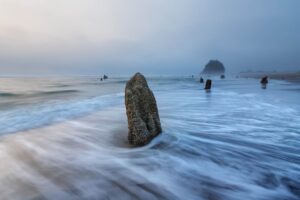
At Cape Disappointment, with the ocean crashing against the rocks and wind tearing across the shoreline, he experiences one of the emotional high points of the journey before Alaska. He shouts into the weather, overwhelmed not by fear but by the sheer force of being alive and untethered. The scene feels almost triumphant. He has crossed the country. He has made himself into the person he wanted to be, or at least believes he has.
There are no crowds in this moment, no cities, no obligations—just ocean, cliffs, storm, and a man at the edge of the continent.

About the place
Address: 244 Robert Gray Dr, Ilwaco, WA 98624, USA
The name “Cape Disappointment” sounds bleak, but it comes from maritime history rather than emotional truth. The area was named in 1788 by Captain John Meares, who failed to find the mouth of the Columbia River in heavy weather and left frustrated. For modern travelers, the park is anything but disappointing.
It is one of Washington’s most dramatic coastal parks, with old lighthouses, deep forest, rough beaches, and viewpoints over the turbulent Pacific. Beard’s Hollow, in particular, has the same cinematic quality seen in the film—dark rock, cold surf, and a kind of rugged weather-beaten beauty that feels inseparable from the Pacific Northwest.
This is a place where it makes sense to slow down and just take in the view.

Stampede Trail
In the Film
This is the end of the road, and the beginning of the story’s darkest truth.
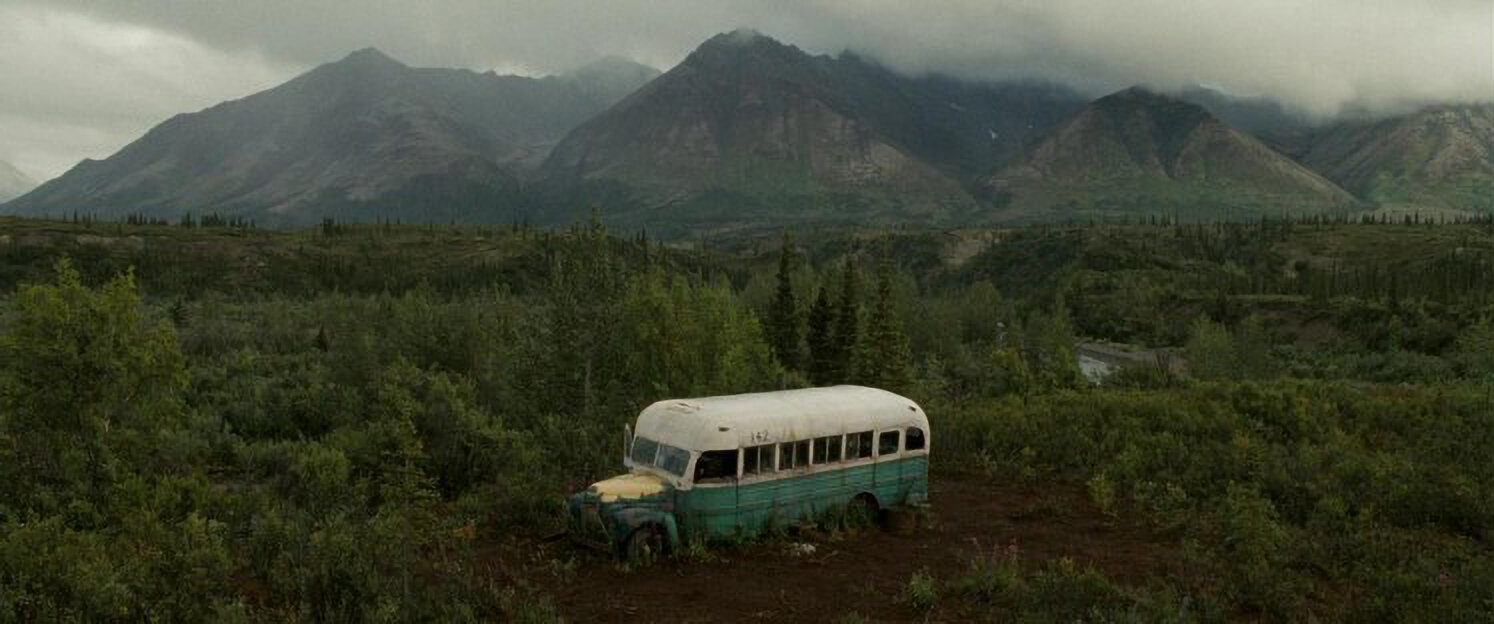
After crossing the Teklanika River, Alexander finds the abandoned Bus 142 in the Alaskan backcountry. The “Magic Bus” becomes his shelter during the final months of his life. At first, it seems like everything he has been looking for: solitude, self-sufficiency, distance from the world. But the film gradually turns. The freedom he wanted becomes harder, colder, and more absolute than he imagined.
Inside that bus, he keeps a journal, reads literature, and comes to the painful conclusion that has become the emotional core of the entire story: happiness is only real when shared. It is a devastating realization because it arrives too late. The place becomes both a shrine to his longing for freedom and a record of its limits.

About the place
Landmark: Healy area, near Denali National Park, Alaska
Stampede Trail is an old mining route dating back to the 1930s. The bus itself, a 1946 International Harvester, had been left there by workers as temporary shelter. For years, it became a place of pilgrimage for travelers from around the world, many of them hoping to retrace McCandless’s path.
In June 2020, Alaska officials removed the bus by helicopter because too many people were risking their lives trying to reach it. Some were rescued. Some died. The romantic image had begun producing real consequences.
Today, the original Bus 142 is housed at the University of Alaska Museum of the North in Fairbanks. Stampede Trail still exists and can still be walked by experienced backcountry travelers, but the bus is gone. What remains is the tundra, the river system, and the same indifferent landscape that shaped the end of McCandless’s story.

Alexander Supertramp’s Trans-American Route: A 14–20 Day Itinerary
This is not the kind of trip you throw together casually. It requires planning, a vehicle, tolerance for long distances, and an honest understanding of what you want from the road. In broad terms, the route can be broken into five stages.
Stage 1: Leaving the South behind
Start in Atlanta at Emory University. It is a fitting opening point because it gives you the clearest contrast between order and escape, between the expected life and the one that waits beyond it.
Stage 2: Desert transformation
From there, either fly or make the long drive west toward Hoover Dam and Lake Mead. Continue into California to visit Salvation Mountain and Slab City. This is one of the most visually distinct sections of the journey, full of desert color, strange roadside mythology, and the kind of landscape that makes reinvention feel plausible.
Stage 3: The prairie spirit
Head north toward South Dakota and the Black Hills. This leg offers a different version of the American interior—wide skies, ranchland, open distances, and the physical scale of the Midwest that helped shape part of Alexander’s story.
Stage 4: To the ocean
Cross the mountain states and make your way to Cape Disappointment in Washington. After the desert and prairie, the Pacific Northwest can feel like a reset. The air changes. The light changes. Even your thoughts tend to change.
Stage 5: Alaska
Finish with a flight to Fairbanks. Visit the original bus at the museum, and if your experience and preparation allow, continue toward Healy to see the beginning of the Stampede Trail area and the Denali country that formed Alexander’s final horizon.
Preparation and practical advice
Traveling in Alexander Supertramp’s footsteps is not an easy, carefree vacation. It is a demanding route that asks more from you than a full tank of gas. As you move across the country—from Georgia’s campuses to California’s desert margins to the silence of the Alaskan tundra—you will cross climates, legal boundaries, comfort zones, and distances that can wear a person down faster than expected.
Some parts of the route, especially in the far north, can be genuinely dangerous for anyone who arrives underprepared. If you want the trip to feel rewarding instead of risky, it helps to understand the details ahead of time, from one-way rental logistics to desert camping rules to the realities of wildlife and weather in Alaska.
Here are some of the most important things to think about before you go.
Logistics: how to connect the route
The biggest practical issue is the one-way rental car.
Because the route goes in one direction, many travelers will pick up a vehicle in one city and return it in another—for example, renting in Atlanta and dropping the car in Seattle before flying to Alaska. That is common enough, but it almost always comes with a drop-off fee, often somewhere in the range of $300 to $1,000. Large rental companies such as Enterprise, Hertz, and Avis tend to offer the best network of pickup and return locations, which makes a long route like this easier to manage.
If you are under 25, expect an additional young driver fee. In some cases, that extra charge can dramatically increase the overall rental cost, so it is worth building that into your budget from the start rather than being surprised later.
Wild camping and where you can actually stop
Alexander often slept in a tent or in his vehicle, but that does not mean you can simply pull over anywhere in the United States and do the same. Wild camping laws vary, and some places are much stricter than they look.
Anza-Borrego
Dispersed camping is allowed in parts of the park, but ground fires are taken very seriously. Open fires directly on the soil are prohibited. If you want a fire, it generally needs to be contained in a proper metal fire pan or elevated fire container. Causing a wildfire, even accidentally, can lead to enormous fines and, in severe cases, criminal penalties. If campfires matter to you, rent or buy the right gear before you arrive. Outdoor retailers like REI usually carry collapsible fire pans and similar equipment.
Slab City
Slab City may look lawless, but it still has its own social rules, and visitors do better when they respect them. Arrive in daylight if you can. Bring extra water and food. Do not wander into private camps uninvited, and do not photograph residents without permission. Pack out your trash. Be cautious around dogs, some of which are protective of their owners’ space.
A useful budget option
For inexpensive overnight stops while driving long distances, some Walmart parking lots and major truck-stop chains such as Love’s may allow overnight vehicle parking, though policies vary by location. When that fails, road motel chains like Motel 6, Super 8, and Days Inn are usually the most practical fallback. It helps to keep apps such as HotelTonight or Choice Hotels on your phone in case you need to find a room quickly.

Alaska safety: Stampede Trail
This is the most dangerous portion of the route, and it deserves respect.
Rivers
The Teklanika River, which trapped McCandless, is dangerous because it is fed by glacier melt. Water levels can rise fast, sometimes by several feet in just a few hours if melting intensifies upstream or heavy rain moves through the mountains. Experienced travelers often try to cross glacial rivers early in the morning, when meltwater flow is usually lower. Even then, conditions can change. It is wise to carry enough food to wait out high water for several days if necessary.
Wildlife
Near Denali, you are in bear country. Both grizzlies and black bears live in the region. Bear spray should be immediately accessible—not buried in a backpack, but attached to your belt or chest strap. Food and scented toiletries, including toothpaste, should be stored away from your sleeping area in bear-resistant containers. A clean camp matters. Smell carries.
Communication
Cell service in the tundra is unreliable or nonexistent, and the landscape can become disorienting even for people who think they know what they are doing. A satellite communicator such as a Garmin inReach or Zoleo is one of the few dependable ways to call for help or share your location. Do not rely on your phone alone. Cold temperatures can drain batteries quickly, and electronics fail more often than people like to admit. A paper map and compass still belong in any real emergency kit.
Hypothermia and clothing
Even in summer, Alaska can turn from mild to punishing in very little time. Rain, wind, and cold can move in fast, and wet clothing is a serious problem. Cotton is a poor choice because it holds moisture and sheds heat. Layering works better: synthetic or merino base layers, fleece or similar insulation, and a waterproof outer shell. Staying dry matters as much as staying warm.
What to bring: the “Supertramp” gear list
Paper maps and a road atlas
In the deserts of the Southwest and the wide emptiness of Alaska, GPS is not infallible. Phones overheat. Batteries die. Signals vanish. A paper road atlas—something classic and dependable, like Rand McNally—gives you a backup that does not care about reception or electricity. Paper maps also often show minor roads, water access points, and other details digital navigation can miss.
Extra water and jerry cans
In Arizona, Nevada, and parts of California, dehydration creeps up quickly. Keep at least 10 to 15 liters of drinking water per person in the car as an emergency reserve, especially if you are driving remote roads where a breakdown could leave you waiting for help in the heat. A hydration bladder for day hikes is useful too, especially in canyon country where carrying water by hand gets old fast.
Books
To better understand what was happening in Chris’s mind, it helps to read some of the writers he carried with him. Thoreau’s Walden belongs naturally on this kind of trip, as does Jack London’s The Call of the Wild. Tolstoy also matters. In a journey built around distance and solitude, books are not just entertainment. They become companions and, sometimes, arguments you keep having with yourself.
Reliable boots and a multitool
Do not cut corners on footwear. Boots should already be broken in, supportive, and sturdy enough for rocky ground and thorny terrain. And a good multitool earns its place quickly. Small repairs, food prep, camp fixes, and unexpected problems all come up on trips like this. McCandless made avoidable mistakes by not having the right gear for practical tasks. There is no need to repeat them.
Advice for travelers
The smartest way to do this route is not necessarily all at once. In many cases, it makes more sense to divide it into two or three separate trips: the Southwest on its own, the Pacific Northwest on its own, and Alaska as a separate block. That gives each region room to breathe and makes the logistics less punishing.
In the desert, plan early starts. Daytime heat in California and Nevada can become exhausting very quickly, and many trails feel far more manageable in the first hours after sunrise.
In Slab City, act like a guest. Do not wander through private camps, do not film people casually, arrive before dark, and bring more water and food than you think you need.
At the Grand Canyon, and especially anywhere involving the river, follow the park rules. Large fines have a way of ruining both a trip and the mood of it.
And above all, do not romanticize Alaska too much. The Magic Bus was removed not because officials wanted to spoil anyone’s myth, but because people were truly getting hurt and sometimes killed trying to recreate what they saw in the film. What happened to Christopher McCandless continues to move people because it speaks to something deep and restless in modern life. But the lesson is not that danger makes a journey meaningful. The lesson is more complicated than that.
That may be exactly why the story still stays with people.
Related Reads